Exam printing is a bulk job with no room for error
Exam papers look like simple print. Black text on white paper, stapled, in a stack. In bulk, they are one of the most demanding jobs a printer handles. The content is confidential until the minute the exam starts. Every copy must be complete, in the right order and in the right version. Quantities have to match the candidate count at each venue, with a margin but not a pile of spares lying around. And the date is fixed. An exam cannot be moved because the papers are late.
This guide is for schools running internal exams, tuition and enrichment centres, private education providers, training organisations, professional bodies running certification tests, and university departments. It covers how to plan a bulk exam print run, how to keep papers secure, how collation and counting are done, and how to pack papers so each venue or classroom gets exactly what it needs.
National examinations in Singapore have their own processes run by the relevant authorities. This article is about the much larger volume of exams and assessments that organisations print themselves or through a commercial printer.
Plan the run backwards from the exam date
Exam printing usually gets squeezed. Papers are written and vetted late, and a typo found during moderation means a new file. Work backwards from the first paper:
- Delivery to venues, with time for the exam office to check and store papers securely.
- Packing by venue, room or class, which takes longer than printing for large exams with many rooms.
- Collation and counting checks, especially for multi-section papers with separate answer booklets.
- Printing, which for black-only digital work is often the quickest step.
- Final files, with a hard cut-off agreed with the printer.
If you run exams every term, set the schedule once and repeat it. A recurring calendar, like the one we describe for workbooks and worksheets on a school term calendar, lets the printer reserve capacity in exam weeks, when demand from other schools peaks at the same time.
Security from file to classroom
A leaked paper means rewriting and reprinting under even more pressure, and it damages trust with students and parents. Security has to cover every step, not only the printing.
Files
- Send files through a secure link with access limited to named people at the printer, not as email attachments to a shared inbox.
- Use clear but discreet file names, such as a paper code, rather than "Sec 3 Maths Final Exam.pdf".
- Ask how long files are kept and confirm they are deleted after the job, unless you want them archived for reprints.
Production
- Agree who at the printer handles the job, and ask that it is printed in a controlled area rather than on an open counter.
- Test prints, spoilt sheets and overs should be shredded, not thrown in general waste.
- For high-stakes papers, a confidentiality agreement is reasonable to ask for.
Packing and delivery
- Seal each pack with tamper-evident tape or a security envelope that shows if it has been opened.
- Deliver directly to a named person, with a signed handover note listing the packs.
Our guide on variable data at volume explains how numbering each copy adds another layer of control, since a missing or leaked copy can then be traced.
Collation, versions and answer booklets
A typical exam paper has a cover page with instructions, the question pages, and sometimes a separate answer booklet, a formula sheet, an insert with a map or a data table, or optical answer sheets for multiple choice. Each item must be in every pack, in the right number.
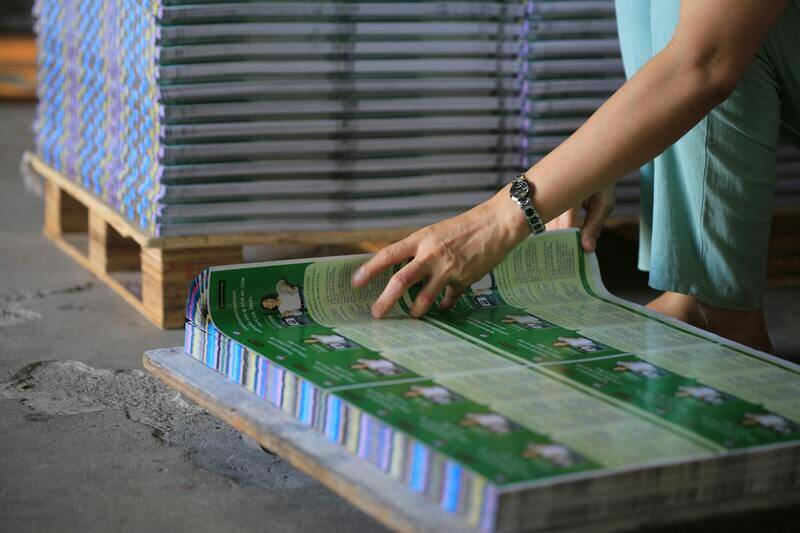
- Booklet or stapled sets: papers up to a certain thickness are saddle-stitched as a booklet, which keeps pages in order. Larger papers are corner-stapled or side-stapled.
- Separate items: inserts and answer booklets are printed separately and counted into each pack, or placed on desks by invigilators.
- Multiple versions: some exams use two or more versions with questions in a different order. Each version should have a visible code on every page and a different colour cover or a printed mark, so invigilators can hand them out correctly.
- Optical answer sheets: these must be printed to the specification of the scanning system, with exact positions and ink. Use the template from the scanner vendor and test a few printed sheets before the full run.
Page order mistakes are the most common error in exam printing. A missing page or a duplicated one is found by a candidate in the middle of the exam, which is the worst possible time. A printer should spot-check sets from each batch, and you should check a sample before the packs are sealed. A simple method is to flip through each sampled set and read only the page numbers, which takes seconds per copy and catches most collation faults.
Counting and packing by venue
For a single school, packing may be by class or exam room. For a training provider or professional body, it may be by test centre across Singapore or the region. Either way, the packing list is the backbone of the job.
| Field on the packing list | Why it matters |
|---|---|
| Paper code and version | Prevents the wrong paper in the wrong room |
| Venue and room | Lets the exam office distribute without opening packs |
| Session date and time | Packs are opened only for the correct session |
| Candidate count plus spares | Enough copies for late registrations, but no large surplus |
| Contents | Number of papers, answer booklets and inserts in the pack |
Packs are usually counted in fixed multiples, such as tens or twenty-fives, with the remainder in a clearly marked smaller bundle. Ask for a printed label on each pack that matches the packing list line, so the person receiving it can tick it off. The same principles apply to any bulk run split across sites, as we explain in distributing a bulk print run to multiple branches.
Paper, print quality and accessibility
Exam papers should be easy to read under classroom lighting and easy to write on. An 80 gsm uncoated paper is the common choice, and slightly heavier paper reduces show-through on double-sided pages. Diagrams and graphs need enough contrast to survive black-only printing, so check any colour charts in greyscale before sending the file.
Plan for candidates who need adapted papers, such as enlarged print on A3, a different paper colour for students with visual stress, or papers with extra spacing. These are small quantities but they must be just as secure and arrive in the same packs, clearly labelled for the right candidate.
Bulk exam printing with us
We print exam papers, assessment booklets, answer booklets and optical answer sheets in volume for schools, tuition centres, training providers and certification bodies. Jobs are handled by a named team, files are deleted after the job on request, and we pack and label by venue, room and session from your packing list, with sealed packs and a signed handover.
If you have an exam period coming up, tell us the dates, the number of papers and candidates, and when the final files will be ready. We will reserve production time in exam weeks and agree file cut-offs with you. You can reach us through our contact page, or read more about our document printing services.